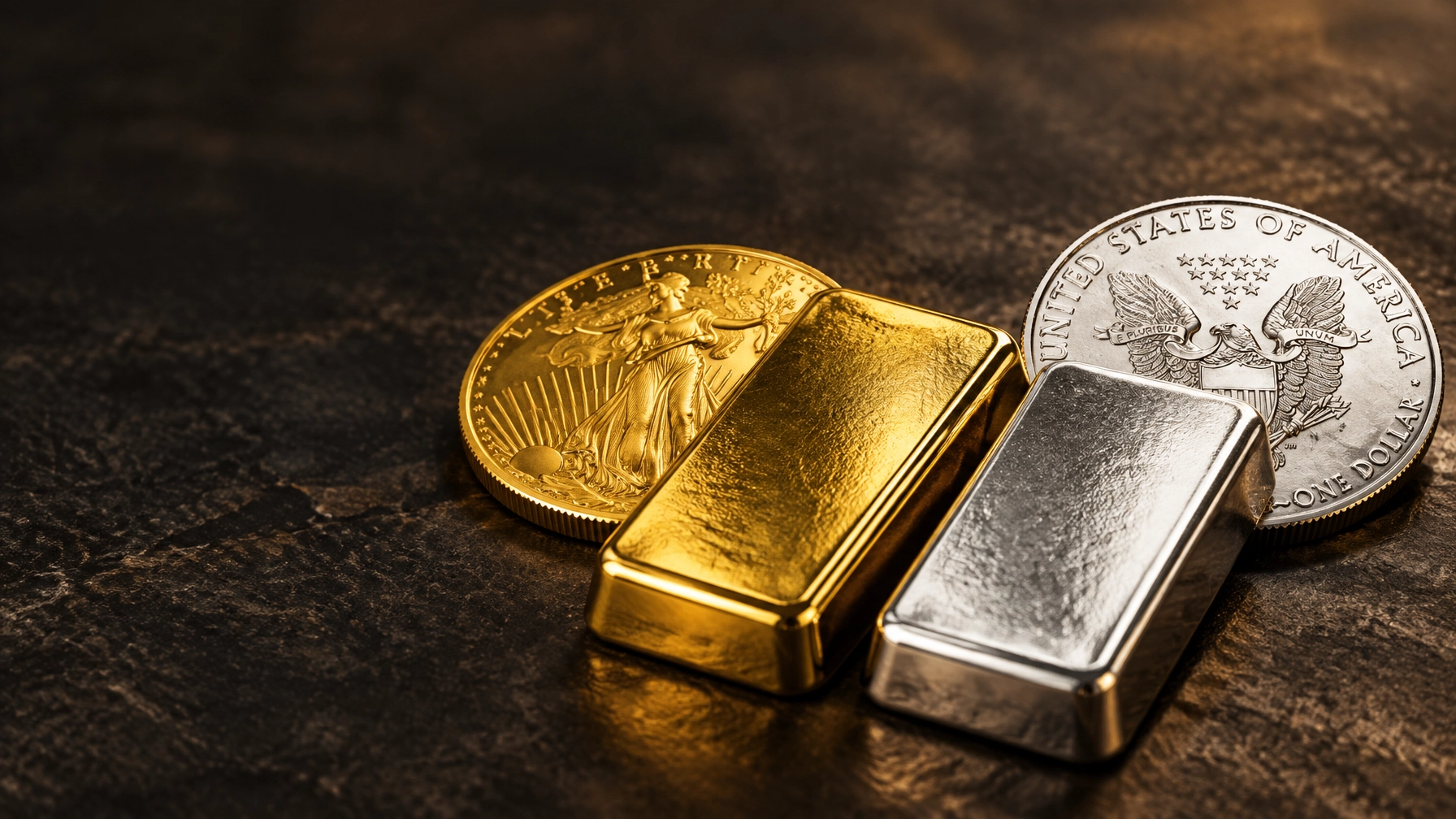
Gold and silver are both tangible assets. Both have served as money for thousands of years. Both can help diversify savings beyond paper promises and traditional banking systems.
They are not interchangeable, however.
Gold is usually the steadier reserve asset. Silver is usually the more accessible and more volatile metal. The right choice depends on your budget, time horizon, storage preferences, and tolerance for price movement.
Many families choose both.
The Short Answer
Choose silver when you want:
- A lower entry cost.
- More ounces for your money.
- Greater divisibility.
- Potential upside tied to industrial demand.
- A practical starting point for a physical silver investment.
Choose gold when you want:
- Higher value in a smaller storage footprint.
- A history of monetary use.
- Lower volatility than silver.
- Exposure to central-bank and reserve-asset demand.
- A core holding for long-term wealth preservation.
Do not choose based on headlines alone. Choose based on the job you want the metal to perform.
Gold vs. Silver Price and Entry Cost
Price is one of the clearest differences.
As of September 2026, indicative market levels place gold near the mid-$4,000s per ounce and silver near the mid-$60s per ounce. Prices change throughout the day, and physical products include market-based pricing, fabrication, and distribution considerations. Review current precious-metals prices before placing an order.
The practical difference remains substantial:
- One ounce of gold represents several thousand dollars.
- One ounce of silver generally costs a much smaller amount.
- Silver allows a new buyer to begin with a single bar or coin.
- Gold requires more capital for each ounce, but stores more value in less space.
For example, Gold Your Money offers one-ounce silver bars and a range of gold and silver bullion bars. Product pricing changes with the market, so use listings as current examples rather than permanent quotes.
Silver is more accessible. Gold is more compact.
That distinction matters when you are building gradually, managing a family trust, or allocating a larger retirement balance.
Volatility: Silver Moves More in Both Directions
Silver generally experiences larger price swings than gold.
Silver has two major sources of demand. It is both a monetary metal and an industrial metal. That creates opportunity, but it also creates additional sensitivity to economic cycles, manufacturing demand, interest rates, and investor sentiment.
Gold has a broader monetary identity. Central banks hold gold as a reserve asset. Investors often turn to it during periods of currency concern, geopolitical stress, and market uncertainty.
Silver can outperform gold during strong precious-metals rallies. It can also decline more sharply when markets turn defensive.
Treat that difference seriously.
Silver offers more potential upside, but it demands more patience. Gold usually offers a steadier ride.
Neither metal is a guaranteed profit. Both can decline in value after purchase. Physical metals should support a diversified financial plan, not replace emergency savings or necessary liquidity.
Use the Gold-Silver Ratio as a Framework
The gold-silver ratio measures how many ounces of silver equal the price of one ounce of gold.
For example, a ratio of 67 to 1 means one ounce of gold is priced near the value of 67 ounces of silver.
The ratio is not a prediction tool. It is a relative-value framework.
When the ratio rises, silver has become less expensive relative to gold. Some buyers may view that as a reason to consider adding silver. When the ratio falls, silver has outperformed gold. Some investors may then favor gold for stability or rebalance toward their target allocation.
Use the ratio to ask better questions:
- Is silver unusually weak or strong compared with gold?
- Does my portfolio need more stability or more growth potential?
- Am I comfortable with silver’s larger price swings?
- Would a blend of both metals better match my goals?
Do not buy silver simply because the ratio looks attractive. Consider industrial demand, product premiums, storage, and your time horizon as well.
Silver’s Industrial Demand Story
Silver has important industrial uses that gold does not share to the same degree.
Manufacturers use silver because it conducts electricity and heat efficiently and resists corrosion. Demand is connected to:
- Solar panels.
- Electronics.
- Electric vehicles.
- Charging infrastructure.
- High-speed transmission equipment.
- Medical and industrial applications.
- Data-center and artificial-intelligence infrastructure.
Solar remains a major part of the story. At the same time, manufacturers are working to reduce the amount of silver used per solar cell. That process, known as thrifting, can limit demand growth even as installations expand.
The result is a balanced picture. Electrification, data centers, and advanced electronics can support long-term demand. Manufacturing efficiency and economic slowdowns can create periods of weakness.
Silver is therefore more connected to the productive economy.
Gold’s Monetary and Central-Bank Role
Gold has industrial uses, but its primary identity is monetary.
Governments and central banks hold gold reserves because gold has no issuer, no corporate balance sheet, and no promise from a private counterparty. It is a tangible reserve asset that has remained recognizable across cultures and centuries.
Gold can serve as:
- A long-term store of value.
- A hedge against currency and monetary uncertainty.
- A portfolio diversifier.
- A reserve asset outside the traditional banking system.
- A legacy asset that can be passed to future generations.
Gold does not depend on an earnings report or dividend payment. Its value comes from scarcity, durability, global recognition, and demand for an asset independent of a single government or institution.
That is why many investors use gold as the foundation of a precious-metals allocation.
Storage Footprint and Divisibility
Storage is a practical issue that buyers often overlook.
Gold stores significant value in a small space. A few gold coins or bars can represent a substantial allocation. This makes gold easier to store, transport, and organize.
Silver is more divisible. A buyer can purchase individual one-ounce coins, small bars, or larger bars over time. That can make silver useful for gradual accumulation.
Silver also requires more physical space for the same dollar value. A large silver allocation can become heavy and bulky, particularly when purchased in ten-ounce, hundred-ounce, or kilo bars.
Consider the balance:
Gold offers compact value. Silver offers smaller units.
For home delivery, choose products you can store responsibly. For retirement accounts, IRA-owned metals must generally be held by an eligible custodian and approved depository. They should not be stored at home.
Gold and Silver in an IRA, 401(k), TSP, 403(b), or 457(b)
A properly structured precious-metals IRA can hold certain IRS-approved gold and silver coins and bullion.
Under the IRS rules, qualifying bullion generally must meet minimum fineness standards:
- Gold, at least .995 fineness.
- Silver, at least .999 fineness.
- Platinum and palladium, at least .9995 fineness.
The metals must be held by an eligible trustee or custodian. Review the IRS guidance in Publication 590-A and Publication 590-B before establishing an account.
A direct gold IRA rollover may be available for eligible funds from a 401(k), 403(b), 457(b), or other retirement account. The exact process depends on your plan, employment status, account type, and custodian.
A direct trustee-to-trustee transfer is generally the cleaner approach. It helps avoid taking personal possession of retirement funds and reduces the risk of missing a rollover deadline. Confirm your options with your plan administrator and a qualified tax professional.
The TSP has a narrower investment menu. Its standard options include the G, F, C, S, and I Funds, along with Lifecycle Funds. It does not directly hold physical gold or silver. Federal employees seeking physical metals may need to review whether a rollover from an eligible TSP balance is permitted.
A gold IRA or silver IRA can offer tax-advantaged ownership, but it is not automatically tax-free. Traditional and Roth accounts follow different tax rules. Understand the account structure before moving money.
Gold may serve as the core holding for stability. Silver may provide a smaller satellite allocation for accessibility and industrial exposure. Your mix should reflect your time horizon and risk tolerance.
Gold or Silver: Which Should You Buy?
Use this simple framework:
Buy Silver If:
- You are starting with a smaller amount.
- You want to accumulate ounces over time.
- You accept higher volatility.
- You want exposure to industrial demand.
- You value divisibility and lower-cost individual units.
Explore silver bars and coins to compare available formats.
Buy Gold If:
- You prioritize stability over maximum movement.
- You want to store substantial value efficiently.
- You view precious metals as long-term wealth insurance.
- You want exposure to central-bank reserve demand.
- You are completing a gold IRA rollover or building a retirement allocation.
Review options to buy gold bars and compare bar sizes, purity, and liquidity.
Consider Both If:
- You want gold’s reserve-asset status and silver’s accessibility.
- You are protecting a family legacy over decades.
- You want to balance compact value with divisibility.
- You understand that silver will likely move more sharply.
- You prefer a diversified precious-metals allocation.
Choose a Partner, Not Just a Product
The metal matters. The transaction matters too.
At Gold Your Money, we provide access to physical gold and silver for direct delivery and eligible retirement accounts. Our core differentiators include:
- Lowest industry spreads.
- Full wholesale buyback with no broker charge.
- 3-5 day delivery.
We help buyers compare gold, silver, bars, coins, and retirement-account options based on their actual goals. We do not believe every family needs the same allocation.
Start with your budget, your time horizon, and your comfort with volatility. Then choose the metal that fits the job.
Whether you begin with silver, buy gold bars, or blend both inside a retirement strategy, focus on tangible assets, disciplined decisions, and long-term security.
Protect What You’ve Built.
This article is for educational purposes only and is not tax, legal, or investment advice. Precious-metals prices can rise or fall. Consult qualified professionals regarding your individual financial and retirement-account decisions.